Temat środowiska jest bliski społeczności Uniwersytetu Warszawskiego. Chcielibyśmy wspólnie dążyć do bardziej zrównoważonej przyszłości, wyznaczając standardy w obliczu kryzysu klimatycznego. Uniwersytet Warszawski - jako największa uczelnia w Polsce - ma wyjątkową możliwość, by dawać przykład innym szkołom wyższym, instytucjom publicznym i całemu społeczeństwu.
Eksperci z wielu uznanych instytucji i organizacji - takich jak Uniwersytet Oksfordzki, Good Food Institute czy polski REV Institute - podkreślają, że zwiększenie udziału produktów roślinnych w systemie produkcji żywności jest jednym z najskuteczniejszych sposobów przeciwdziałania problemom środowiskowym.
Rolnictwo odpowiada za około 70% globalnego śladu wodnego [1], a produkcja zwierzęca zużywa znacznie więcej wody niż roślinna - zarówno w przeliczeniu na masę gotowego produktu żywnościowego, jak i jego kaloryczność czy zawartość białka [2, 3]. Hodowla zwierząt oraz produkcja pasz wymagają dużych powierzchni rolnych i stanowią dominujące przyczyny wylesiania [4], w szczególności w Amazonii, gdzie odpowiadają nawet za 80% wycinki lasów [5]. Przemysłowa hodowla zwierząt to także znaczne emisje gazów cieplarnianych [6–8], zwiększone ryzyko kolejnych pandemii [9], zanieczyszczenie środowiska, utrata bioróżnorodności [10] i niski dobrostan zwierząt hodowlanych [11–13].
W związku z tym zwracamy się z prośbą o stworzenie w pełni roślinnej uniwersyteckiej stołówki z ofertą niezawierającą produktów odzwierzęcych.
Uniwersytet Warszawski powinien wspierać i promować roślinną transformację żywnościową jako część strategii na rzecz klimatu oraz zrównoważonego rozwoju. Poprzez wspólne podjęcie odpowiednich działań możemy minimalizować nasz negatywny wpływ na środowisko i razem zadbać o naszą przyszłość.
Uprzejmie prosimy o pozytywne rozpatrzenie naszego wniosku.
Z wyrazami szacunku,
społeczność Uniwersytetu Warszawskiego
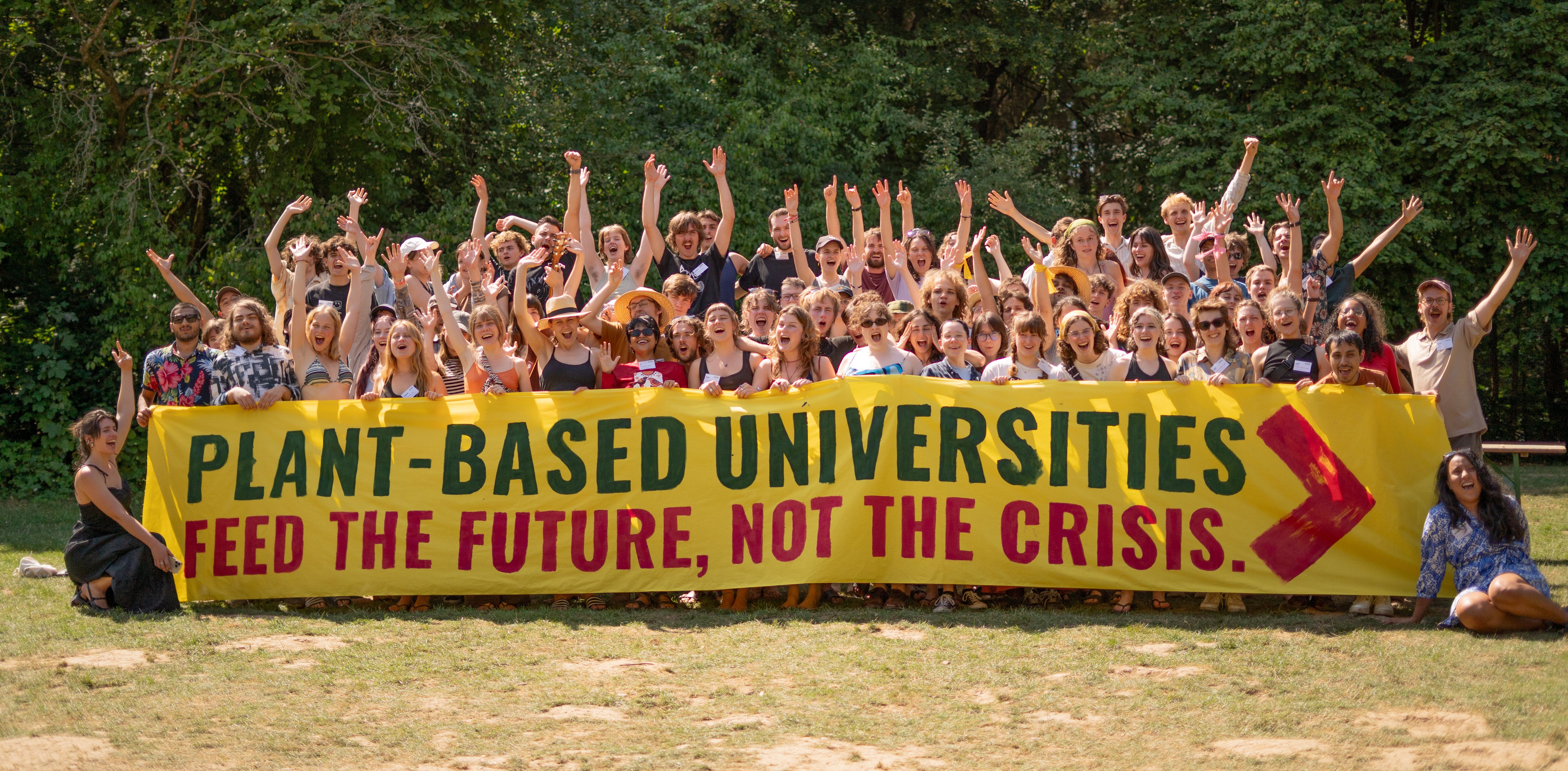
Kampania Plant-Based Universities to grupa studencka aktywna obecnie w ponad 80 uniwersytetach w Unii Europejskiej oraz Wielkiej Brytanii. Jeśli chcesz z nami nawiązać kontakt, napisz wiadomość na instagramie do lub wyślij maila na pbu.waw@uw.edu.pl.
-
To the honourable Rector of the University of Warsaw,
The topic of the environment is one of great importance to the community of the University of Warsaw. We wish to strive for a more sustainable future, setting standards in the face of the climate crisis. The University of Warsaw — as the biggest university in Poland — possesses the remarkable opportunity to set an example for other academic and public institutions and for the entire society.
Experts from many esteemed institutions and organizations — such as the University of Oxford, Good Food Institute or the Polish REV Institute — emphasize that increasing the role of plant-based products in the food production system constitutes one of the most effective ways of counteracting environmental problems.
Agriculture accounts for around 70% of the global water footprint[1], and animal production consumes significantly more water than plant production across all metrics: food product weight, caloric value, protein content[2, 3]. Livestock farming and feed production require large areas of agricultural land and are the primary causes of deforestation[4], particularly in the Amazon, where they account for as much as 80% of forest clearing[5]. Industrial animal farming also contributes to substantial greenhouse gas emissions[6–8], an increased risk of subsequent pandemics[9], environmental pollution, loss of biodiversity[10], and compromised welfare of farmed animals[11–13].
With the above considerations in mind, we respectfully request the creation of a fully plant-based university canteen.
The University of Warsaw should support and promote the transition to a global plant-based food system as part of efforts for climate action and sustainable development. Through collective action we are able to mitigate our negative impact on the environment and ensure a safe future.
We kindly ask you to grant our request.
With kind regards,
The community of the University of Warsaw
Plant-Based Universities is a student network active in over 80 universities in the European Union and Great Britain. If you would like to get in touch, contact our instagram account or send an e-mail: pbu.waw@uw.edu.pl.
[1] Peter H. Gleick, red. The World’s Water. Washington, DC: Island Press/Center for Resource Economics,2014. isbn: 978-1-59726-421-1 978-1-61091-483-3. doi: 10.5822/978-1-61091-483-3. url: http://link.springer.com/10.5822/978-1-61091-483-3.
[2] Hannah Ritchie i Max Roser. “Water Use and Stress”. W: Our World in Data (1 lip. 2018). url: https://ourworldindata.org/water-use-stress.
[3] Mesfin M. Mekonnen i Arjen Y. Hoekstra. “A Global Assessment of the Water Footprint of Farm Animal Products”.W: Ecosystems 15.3 (1 kw. 2012), s. 401–415. issn: 1435-0629. doi: 10 . 1007 / s10021 - 011 - 9517 - 8. url: https ://doi.org/10.1007/s10021-011-9517-8.
[4] Hannah Ritchie. “Drivers of Deforestation”. W: Our World in Data (4 lut. 2021). url: https://ourworldindata.org/drivers-of-deforestation.
[5] Daniel C Nepstad i in. “Interactions among Amazon Land Use, Forests and Climate: Prospects for a near-Term ForestTipping Point”. W: Philosophical Transactions of the Royal Society B: Biological Sciences 363.1498 (27 maj. 2008), s. 1737–1746. issn: 0962-8436. doi: 10 . 1098 / rstb . 2007 . 0036. PMID: 18267897. url: https : / / pmc . ncbi . nlm . nih . gov /articles/PMC2373903/.
[6] Hannah Ritchie. “Food Production Is Responsible for One-Quarter of the World’s Greenhouse Gas Emissions”. W: OurWorld in Data (6 list. 2019). url: https://ourworldindata.org/food-ghg-emissions.
[7] Michael A. Clark i in. “Global Food System Emissions Could Preclude Achieving the 1.5° and 2°C Climate Change Targets”.W: Science 370.6517 (6 list. 2020), s. 705–708. doi: 10.1126/science.aba7357. url: https://www.science.org/doi/10.1126/science.aba7357.
[8] Anna Sierpińska. Klimatyczny ślad kotleta. Nauka o klimacie | naukaoklimacie.pl. 29 paź. 2019. url: https://naukaoklimacie.pl/aktualnosci/klimatyczny-slad-kotleta-386.
[9] International Livestock Research Institute i United Nations Environment Programme. Preventing the Next Pandemic:Zoonotic Diseases and How to Break the Chain of Transmission. 2020. isbn: 978-92-807-3792-9. url: https://wedocs.unep.org/handle/20.500.11822/32316.
[10] J. Poore i T. Nemecek. “Reducing Food’s Environmental Impacts through Producers and Consumers”. W: Science 360.6392(czer. 2018), s. 987–992. doi: 10.1126/science.aaq0216. url: https://www.science.org/doi/10.1126/science.aaq0216.
[11] EFSA Panel on Animal Health and Welfare (AHAW) i in. “Welfare of Pigs on Farm”. W: EFSA Journal 20.8 (2022),e07421. issn: 1831-4732. doi: 10.2903/j.efsa.2022.7421. url: https://onlinelibrary.wiley.com/doi/abs/10.2903/j.efsa.2022.7421.
[12] EFSA Panel on Animal Health and Animal Welfare (AHAW) i in. “Welfare of Laying Hens on Farm”. W: EFSA Journal21.2 (2023), e07789. issn: 1831-4732. doi: 10.2903/j.efsa.2023.7789. url: https://onlinelibrary.wiley.com/doi/abs/10.2903/j.efsa.2023.7789.
[13] EFSA AHAW Panel (EFSA Panel on Animal Health and Welfare) i in. “Welfare of Broilers on Farm”. W: EFSA Journal21.2 (2023), e07788. issn: 1831-4732. doi: 10.2903/j.efsa.2023.7788. url: https://onlinelibrary.wiley.com/doi/abs/10.2903/j.efsa.2023.7788.
-2.jpg)
.jpeg)
-1.jpg)